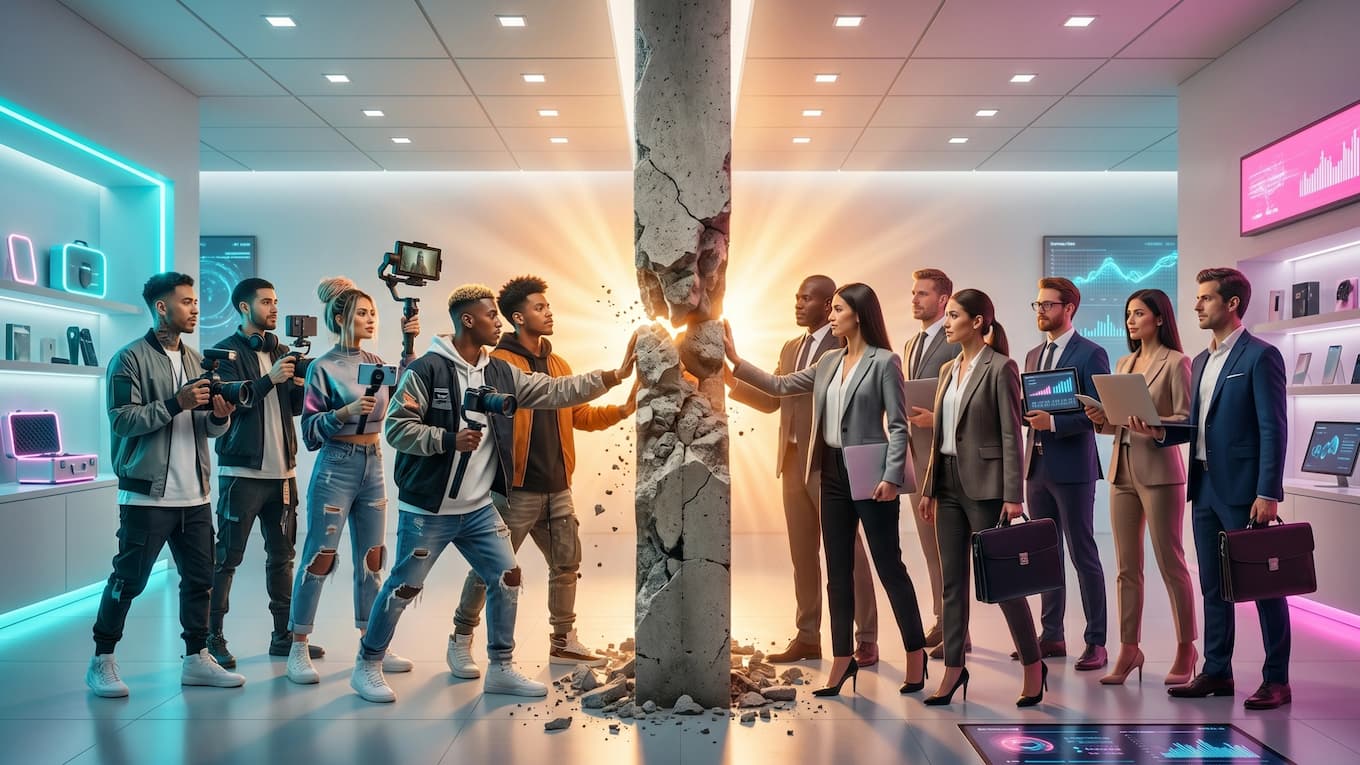
For years, influencer marketing has operated in a strangely chaotic way for an industry worth billions.
Having spent a lot of time trying to match brands with creators for campaigns myself, I’ve always been surprised by how manual and difficult the whole process still is.
Brands:
- manually searching creators
- sending cold emails
- asking for audience stats
- trying to compare engagement screenshots
- arguing over usage rights
- managing campaigns in spreadsheets that look like they survived the fall of MySpace
For an industry built around modern digital platforms, the entire process often feels oddly unscalable.
Meanwhile, Google has been sitting there owning:
- YouTube
- Google Ads
- Google Analytics
- shopping data
- audience data
- search intent
- conversion tracking
- AI infrastructure
…and apparently only just realised these things could perhaps be connected together.
Naturally, they’re now calling this evolution “YouTube Creator Partnerships.”
Not the catchiest name in the world, admittedly, but the underlying shift is potentially enormous.
Still — despite the branding — I actually think this is one of the most strategically important moves Google has made in years.
Creator Marketing Was Never Supposed To Stay This Manual
The strange thing about influencer marketing is that it somehow remained operationally primitive long after digital advertising became deeply automated.
We can:
- algorithmically optimise bids in milliseconds
- dynamically personalise ads
- predict conversion likelihood
- train AI models on behavioural signals
…but brands still spend half their lives emailing:
“Hi, just checking whether you saw my previous email regarding potential collaboration opportunities”
It’s absurd.
And platforms know it.
TikTok Already Showed Everyone Where This Was Heading
The real catalyst here probably wasn’t YouTube itself.
It was TikTok.
Specifically:
- TikTok Shop
- creator affiliates
- Spark Ads
- mass authorisation systems
TikTok realised something extremely important:
the bottleneck isn’t content creation anymore — it’s permissions and coordination.
There is already an endless supply of creators willing to make content.
The friction comes from:
- finding them
- approving them
- licensing the content
- obtaining usage rights
- turning organic content into ads quickly
TikTok massively reduced that friction.
Creators could simply:
- make content
- opt into authorisation
- allow brands to promote it
Suddenly:
- creator content became scalable ad inventory
- brands gained endless native-feeling creatives
- platforms increased ad spend
- everyone became slightly more addicted to dashboards
Modern marketing at its finest.
YouTube Creator Partnerships Feels Inevitable In Hindsight
Honestly, the surprising thing isn’t that Google is building this.
It’s that they waited this long.
Because from a systems perspective, Google already had almost everything required:
- creators
- video infrastructure
- advertisers
- audience data
- shopping systems
- analytics
- attribution
- AI
The pieces were already there.
They just lived in separate silos like relatives avoiding each other at Christmas dinner.
Now Google finally seems to be connecting them together.
And once you view it through that lens, “Creator Partnerships” stops looking like a standalone feature and starts looking like:
YouTube becoming deeply integrated into Google’s advertising infrastructure.
That’s a much bigger shift.
The Really Interesting Part Isn’t Sponsorships
The most important part of this probably isn’t sponsored creator deals at all.
It’s what comes next.
Right now, creators can mention brands organically in videos, but there’s no truly native system where creators can proactively say:
“Hey brand — I made this content featuring your product. Feel free to discover, license or promote it.”
That feels like an obvious next step.
And honestly, it’s difficult to imagine Google not moving in this direction eventually.
Because it solves a huge inefficiency.
Imagine This Workflow
A creator uploads:
“Testing this new beauty product.”
They tick:
- Open to partnerships
- Allow paid amplification
- Brand featured
Now the brand can instantly see:
- videos mentioning them
- audience demographics
- engagement quality
- retention rates
- conversion signals
- promotable assets
without anyone sending:
“Just bumping this to the top of your inbox 😊”
Human civilisation advances.
Google Is Probably Watching TikTok Very Carefully
The bigger strategic issue for Google is this:
Product discovery is changing.
People increasingly discover products through:
- creators
- recommendations
- feeds
- AI assistants
- social proof
rather than simply typing product names into search bars.
That matters enormously to Google.
Because if shopping discovery shifts too heavily toward creator ecosystems, platforms like TikTok stop being “social apps” and start becoming:
- entertainment engines
- shopping engines
- ad networks
- recommendation systems
all simultaneously.
Which is exactly what’s happening.
The Next Logical Step Is Affiliate Commerce
This is where things become particularly interesting.
TikTok has already demonstrated how powerful creator affiliate systems can be.
Creators effectively become:
- decentralised salespeople
- decentralised ad creators
- decentralised product testers
at massive scale.
And Google already owns most of the infrastructure needed to replicate this:
- YouTube
- Google Merchant Center
- Google Ads
- shopping feeds
- conversion tracking
- creator monetisation systems
Again:
connecting systems they already owned.
That phrase keeps becoming more relevant.
YouTube Has One Huge Advantage Over TikTok
TikTok is exceptional at:
- trends
- impulse buying
- rapid discovery
- creator-led commerce
And at this point, it has more than proven that short-form creator content can generate serious revenue.
But YouTube now occupies an interesting middle ground because it owns both:
- YouTube Shorts
- traditional long-form YouTube content
That potentially gives it a very powerful combination of:
- short-form discovery
- long-form persuasion
People actively search YouTube for:
- reviews
- comparisons
- tutorials
- “is this actually worth buying?”
- long-term opinions
That trust layer matters enormously.
A creator saying:
“I’ve tested this for three months…”
often carries a very different level of persuasive weight compared to purely discovery-focused content.
And increasingly, both forms of content may end up feeding into the same advertising and creator partnership ecosystem.
That could become a major advantage for Google.
The Bigger Shift Is That Creator Content Is Becoming Ad Infrastructure
That’s the real takeaway here.
Platforms increasingly no longer view creator content as something adjacent to advertising.
Creator content is the advertising ecosystem now.
The winning ads increasingly look like:
- creators
- UGC
- native content
- personality-led recommendations
rather than polished traditional commercials.
And platforms want systems that can:
- identify winning creator content
- measure it
- license it
- amplify it
- scale it
preferably without requiring 73 email chains and a PDF rate card.
Final Thoughts
I genuinely think YouTube Creator Partnerships could end up becoming one of the most important infrastructure shifts in modern digital marketing.
Not because it suddenly invents influencer marketing.
But because it industrialises it.
Google finally seems to have realised that YouTube creators aren’t merely adjacent to the advertising ecosystem anymore.
They are the advertising ecosystem.
And if history tells us anything, it’s that once Google starts properly integrating systems together, things tend to scale rather quickly.
Frequently Asked Questions
YouTube Creator Partnerships is YouTube’s system for helping brands and creators work together more directly inside the Google ecosystem. It appears designed to simplify creator discovery, campaign management and paid promotion.
Traditional influencer marketing is often fragmented and manual, involving emails, spreadsheets and lengthy negotiations. YouTube Creator Partnerships appears to move toward a more integrated platform-based approach.
Most likely, yes. One of YouTube’s biggest strengths is that it now combines both short-form discovery through Shorts and deeper long-form video content within the same platform.
It certainly feels possible. TikTok has already shown how powerful creator affiliate systems can become, and Google already owns much of the infrastructure needed to build something similar.
It could make creator marketing far easier to scale by simplifying creator discovery, permissions, paid amplification and campaign measurement inside a single ecosystem.
In many ways, yes. TikTok has proven that creator-led commerce and short-form content can drive huge engagement and revenue, and Google appears to be responding by integrating creators more deeply into its advertising and shopping systems.
