
How discovery is changing marketing — and the practical steps businesses can take right now.
If you’ve just read my previous article on how online discovery is changing, you might reasonably be thinking: fine — what am I actually supposed to do about it?
It’s a fair question.
It’s one thing to say people are discovering brands through TikTok, Reddit, YouTube and AI tools before they ever open Google. It’s another thing entirely to turn that into a sensible marketing plan — and, in my experience, “interesting shift” has a habit of becoming “practical problem” rather quickly.
So rather than staring mournfully at your organic traffic and pretending this is all a passing phase, here are the practical things businesses can start doing now.
The Old Discovery Playbook No Longer Works on Its Own
For years, the logic was fairly simple: show up in Google, get the click, convert the customer.
That still matters.
This is not the part where I declare SEO dead, websites irrelevant, and the future entirely owned by AI chatbots and teenagers on TikTok. Search still matters. Your website still matters. Being findable still matters.
But it is no longer enough on its own.
If people now discover brands through creators, communities, social platforms and AI tools before they ever search for them, then visibility can’t just be treated as a search problem anymore.
That’s the part of the playbook that has already changed.
The old model was built around capturing intent at the point of search.
The emerging model is built around earning attention earlier, being recognisable across more touchpoints, and making it easy for people to trust what they find when they eventually check you out.
So rather than rehashing everything that’s changing, it’s more useful to ask a better question:
What do businesses actually need to do differently now?
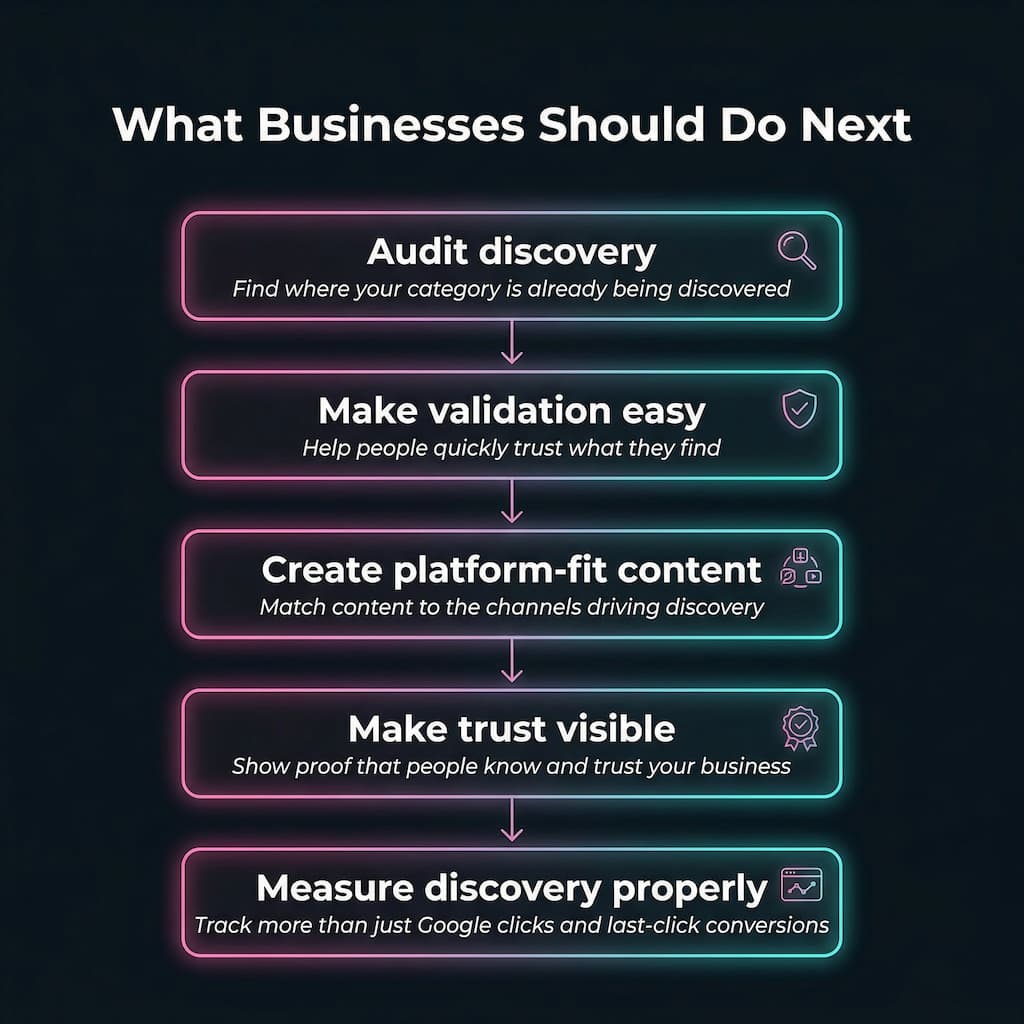
1. Audit Where Discovery Is Already Happening
For a lot of businesses, the first mistake is assuming discovery is changing in the same way for everyone.
It isn’t.
Before you start “reworking your digital strategy”, it would help to know where people in your category are actually discovering things.
That means leaving Google for a bit and doing some manual research.
Search your category, product type, customer problem and brand names on:
- TikTok
- YouTube
- ChatGPT
- Amazon, if relevant
Then document what you find.
You’re looking for:
- the brands that keep showing up
- the creators or accounts that keep appearing
- the questions people repeatedly ask
- the content formats that seem to drive engagement
- whether people are discovering through reviews, recommendations, tutorials, threads or AI answers
A practical starting point is to spend one hour on each platform that might matter and keep notes in one simple document or spreadsheet.
Don’t overcomplicate it. You are not producing a forensic report for Parliament.
You are simply trying to answer a basic question:
Where is discovery already happening in my category?
Because once you know that, you can stop trying to be everywhere and start being useful in the places that actually matter.
A surprising number of businesses would save themselves a lot of time by doing this before making “AI strategy” their entire personality.
2. Make Your Brand Easy to Validate
If discovery increasingly happens elsewhere, then by the time someone reaches your website or searches your brand name, they’re often trying to answer one question:
Are these people legit?
So make that easy.
This is where a lot of businesses still make life harder than it needs to be. Someone has heard about you, typed your name into Google, clicked through to your site, and is now prepared to give you approximately eight seconds to look credible.
Use them wisely.
A practical place to start is this:
- review your homepage headline — is it immediately clear what you do?
- check your branded search results — do they inspire confidence or mild concern?
- make sure reviews, testimonials or case studies are easy to find
- make contact details obvious
- tighten your About page so it sounds like a real business, not a hostage statement
- make product or service pages easy to understand without jargon
If you sell products, make sure the basics are clear: pricing, delivery, returns, product details, and trust signals.
If you sell services, make sure people can quickly understand: what you do, who it’s for, what outcomes you help with, and why they should trust you.
This is not glamorous work, which is probably why so many people avoid it.
But if someone hears about you on TikTok, sees your name in a Reddit thread, or gets you recommended by ChatGPT, they will often go looking for reassurance before they do anything sensible.
Don’t make them work for it.
3. Create Content for the Platforms Driving Discovery
Written content still matters. Blog articles, guides and evergreen pages remain useful for search, AI visibility and building authority.
But their role is changing.
Written content is no longer just there to rank. It can also act as source material — something that can be cited, repurposed, linked back to, and used to support visibility across other formats.
That matters because discovery no longer happens in one place.
If people are finding brands through TikTok, YouTube, Reddit, Instagram and AI tools — and Google’s own data suggests that younger users increasingly turn to TikTok or Instagram for some types of discovery — then content needs to do more than sit politely on a website waiting to be found.
It needs to appear where discovery is already happening.
That means your next move should depend on what came out of your audit.
If YouTube keeps surfacing in your category, that’s a fairly strong clue that useful video content may be worth prioritising. That doesn’t mean building a full studio and reinventing yourself as a YouTuber by Thursday. It might just mean starting with a few useful videos answering common customer questions.
If TikTok is driving discovery, test short-form content that shows products, solves problems, demonstrates before-and-afters, or explains something quickly and clearly.
If Reddit matters in your niche, spend time understanding the relevant communities before participating. Read the threads. Notice the tone. Watch what gets engagement. Then contribute where it makes sense, ideally like a human rather than a brand account that has just been told to “join the conversation”.
If creators influence buying decisions in your category, make a shortlist of the people already talking about similar products or services. Follow them. Study what they post. Look for sensible collaboration opportunities, rather than blindly emailing half the internet and hoping someone fancies a gifted sample.
A practical way to approach this is:
- if YouTube matters, plan 3–5 simple videos around common questions
- if TikTok matters, test short educational or product-led clips
- if Reddit matters, identify the subreddits worth learning from before posting
- if AI tools keep surfacing certain questions, create clear written content that answers those questions on your site
- if creators drive discovery, build a shortlist of relevant people and start researching partnership opportunities
The point is not to produce every possible format.
It is to create the formats most likely to put you where discovery is already happening.
In other words, prioritise the platforms that matter in your category, not the ones the internet is shouting about most loudly this week.
4. Make Trust Visible
If discovery is becoming more recommendation-driven, then one of the smartest things you can do is make your business easier to trust in public.
That trust might show up as:
- reviews
- testimonials
- case studies
- creator mentions
- customer photos or videos
- marketplace ratings
- product roundups
- public discussion in relevant communities
The exact format will vary by business.
For an ecommerce brand, customer reviews, creator content and marketplace feedback may matter most.
For a service business, case studies, testimonials, Google reviews, LinkedIn recommendations and visible past work may carry more weight.
The important thing is not choosing the “perfect” type of proof.
It’s making sure there is enough visible evidence for someone — or something — to conclude that your business is credible.
The job here is not to invent trust. It’s to make existing trust easier to see.
A practical starting point:
- identify the trust signals people in your category actually rely on
- make a list of what you already have
- list what’s missing
- choose one or two gaps to fix this month
That might mean:
- asking more consistently for reviews or testimonials
- turning a successful client outcome into a short case study
- collecting customer photos or user-generated content
- creating a comparison page that helps people evaluate options
- looking for industry roundups, creator lists or community discussions where your brand should reasonably appear
You are not trying to look bigger than you are.
You are trying to make genuine credibility more visible.
Because in a fragmented discovery environment, trust often travels through repetition.
Being good still matters.
But being visibly credible matters more.
5. Stop Measuring Discovery as If Google Is the Only Thing That Counts
If you only measure visibility through Google rankings and organic search clicks, you’ll miss a lot of what’s actually happening — not least because a large share of Google searches now end without a click to another website.
Which would be wonderfully convenient, because it means you could carry on using the same reports and pretending the world hasn’t changed.
Unfortunately, people rarely organise themselves around our reporting preferences.
And to be fair, this part isn’t entirely new.
I was talking about versions of this problem back in the late 2000s, when analytics platforms first started trying to piece together full-path conversions across multiple touchpoints. Even then, I was wary of giving all the credit to the final click while ignoring the channels that helped create the conversion in the first place.
At the time, I used to talk about what I called “part of path conversion” — the idea that more than one channel often deserves credit, even if the reporting platforms weren’t especially good at showing it.
Back then, the journey was usually simpler. People had fewer devices, fewer platforms, and tracking was easier because cookies still had a fighting chance — before they became public enemy number one.
The principle, though, hasn’t changed.
If you only measure the final step, you risk undervaluing the channels that introduced the customer, influenced the decision, or nudged them back later.
What has changed is the level of complexity.
If discovery is now happening across multiple touchpoints, then measurement needs to widen with it. That matters even more as AI tools become part of the discovery journey. McKinsey recently described AI assistants as a new front door to the internet, which is exactly why businesses can no longer afford to measure discovery as if it all starts — and ends — with Google.
That means looking beyond:
- organic traffic from Google
- keyword rankings
- last-click conversions
And paying more attention to:
- direct traffic
- branded search volume
- referral traffic from social and communities
- assisted conversions
- creator or partnership traffic
- simple source-of-enquiry tracking
A practical starting point:
- add a simple “How did you hear about us?” field to enquiry forms, lead forms or post-purchase emails where appropriate
- review branded search trends monthly, not just generic keyword rankings
- make sure links from creators, community placements and campaigns are tagged properly
- look at referral traffic from YouTube, TikTok, Reddit and other relevant sources
- review assisted conversions alongside last-click conversions
Someone might discover you on YouTube, hear about you again on Reddit, search your brand name a week later, and finally convert through a direct visit.
If you only credit the final click, you risk undervaluing the channels that introduced them to you in the first place.
That doesn’t mean attribution becomes easy. It doesn’t. If anything, it becomes more irritating.
But it does mean you need to stop treating Google as the only meaningful indicator of discovery.
Otherwise you’ll keep optimising the bit that’s easiest to measure rather than the bit that’s actually doing the work.
Final Thoughts
You do not need to rebuild your entire marketing strategy overnight.
But you probably do need to stop treating Google as the only place discovery matters.
If I were advising a business to do just three things this month, it would be this:
- audit where discovery is already happening in your category
- make your brand easy to validate
- start building content and proof that travel beyond search
That won’t solve everything.
But it will put you ahead of the businesses still treating fragmented discovery like an interesting theory rather than a practical problem.
And yes, annoyingly, it is now a practical problem.
