
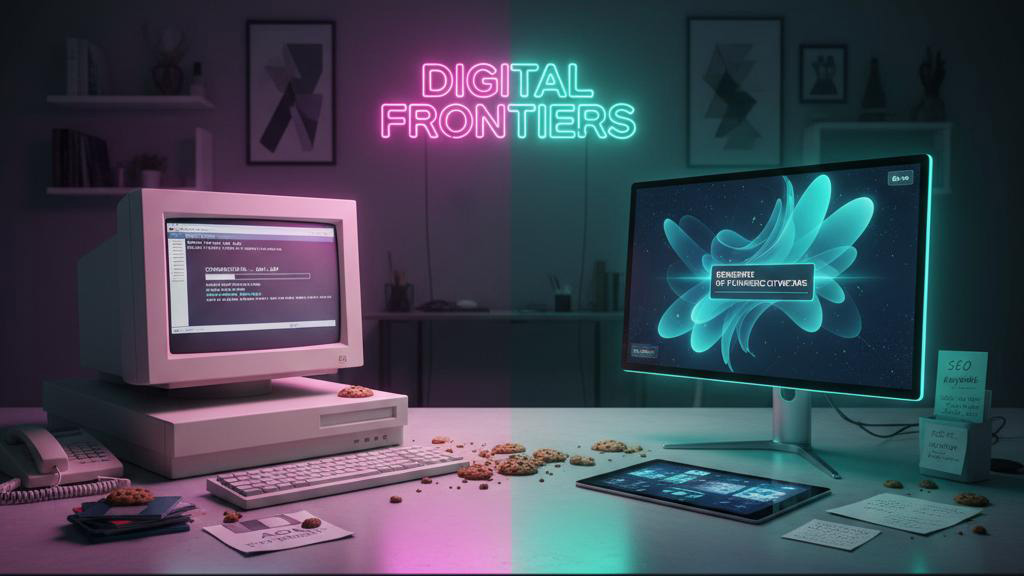
Déjà Vu: My First Encounters with the Internet and AI
My first experience with the internet wasn’t even at home—it was at my workplace. I remember being intrigued by this new digital world, but it wasn’t until I got the internet at home that I truly understood its power. This was the late 90s, right at the turn of the century.
Back then, setting up the internet was an event. You didn’t just plug in a router; you got a disk from your provider to install the software. And because we only had one phone socket, I had to run a cable into the dining room where our PC was set up. It was dial-up, of course, which meant no one could use the phone while I was online. And let’s not forget that glorious symphony of screeching beeps every time you connected—the unmistakable sound of progress. It was frustrating, slow, and noisy—but it didn’t matter. The moment I got online, I felt connected to something much, much bigger. The possibilities seemed endless.
Fast forward to my first real experience with AI, and I felt that same rush of excitement—a sense that the ground beneath us was shifting. I remember my very first conversation with ChatGPT, and it absolutely blew my mind. This wasn’t some clunky chatbot spitting out generic responses—it felt like an actual conversation, a far cry from the days when I used to type commands into my Commodore Amiga in the early 90s and get rigid, pre-programmed responses. I knew right then that AI wasn’t just another tool—it was a paradigm shift.
Then came Midjourney—the first time I used it to generate images, I couldn’t believe what I was seeing. I half expected to find a hidden team of artists locked in a room somewhere generating these visuals manually. ElevenLabs for AI-generated voice, Runway for AI-powered video creation—every new experience felt like another moment of realisation that AI was reshaping entire industries in real time.
Of course, just like the internet, AI is also triggering existential crises. Some people are excited, while others are convinced we’re all training our robotic overlords. And, much like in the early days of the internet, many businesses are staring at AI with a mix of awe and terror, wondering whether they’ll adapt or get left behind.
AI is Changing Search Faster Than Any Google Update Ever Did
SEO has always been about keeping up with Google’s changes. I’ve lived through every major algorithm shift—Panda, Penguin, Hummingbird, RankBrain—you name it. Each time, there was a sense of panic in the SEO world, but nothing compares to what AI is doing now.
AI-generated search results are reducing the need for users to click on websites, replacing organic listings with direct answers. Google’s AI-powered Search Generative Experience (SGE) now summarises multiple sources into a single response, making traditional search rankings less relevant. Meanwhile, AI-written content is flooding the web, creating a new challenge—how do businesses stand out when machines can generate endless streams of text?
If you thought zero-click searches were bad, AI-generated answers are taking things to a whole new level. The way users interact with search is evolving, and businesses need to be prepared for what comes next.
But here’s the catch—AI still relies on websites to provide the information it summarises. If content creators stop producing original material because AI is hoarding traffic, what happens then? The incentive to create valuable content diminishes if Google and AI tools are the ones benefiting from it, while website owners see fewer visitors and conversions.
After all, how many people will continue writing in-depth articles, recording podcasts, or creating tutorials if no one ever clicks through to see them? If AI keeps feeding on content without rewarding its creators, the entire system could become unsustainable. AI might be smart, but last time I checked, it doesn’t have original thoughts—it just borrows from everyone else’s work. So what happens when no one wants to do the work anymore?
The Exciting Side of AI: SEO’s New Superpowers
But let’s not get too dramatic just yet. AI isn’t just here to steal our traffic—it’s also giving SEOs some seriously powerful tools to work with.
AI can significantly speed up research and content creation. While AI-generated content still needs human oversight (because let’s be honest, AI still has a knack for confidently spouting nonsense), it can be an excellent assistant for drafting and structuring articles. AI-powered tools can also analyse vast amounts of data quickly, identifying keyword trends, search intent, and audience behaviour faster than any manual research could.
Beyond content, AI is enhancing personalisation in search. Businesses that implement AI-driven personalisation can deliver tailored content and recommendations, improving engagement and conversion rates. AI is also automating repetitive SEO tasks, such as writing meta descriptions, summarising articles, and optimising on-page elements, freeing up time for strategy and creativity.
For those who embrace AI rather than fear it, it’s an incredible efficiency booster that has the potential to redefine how SEO works in the modern era.
Final Thoughts: AI and SEO—The Next Internet Revolution
I still remember the feeling of plugging in that dial-up modem in the late 90s, running a cable across the dining room, and hearing that awful screeching sound. It was frustrating, slow, and imperfect—but it was the future. And even then, I knew it was going to change the world.
I get that same feeling now with AI. It’s both exhilarating and slightly terrifying. Will AI steal our traffic? Maybe. Will it force businesses to rethink their strategies? Definitely. Will it replace creativity? Absolutely not. No matter how advanced AI gets, it still can’t replicate human experience, original thought, or a well-timed sarcastic remark.
Just like the internet didn’t kill businesses—it changed them, AI isn’t going to kill SEO. It’s going to evolve it. Some will resist. Others will embrace it. But one thing is certain: AI isn’t going anywhere, and neither is search.
So, the only real question is—are you adapting? 🚀
