
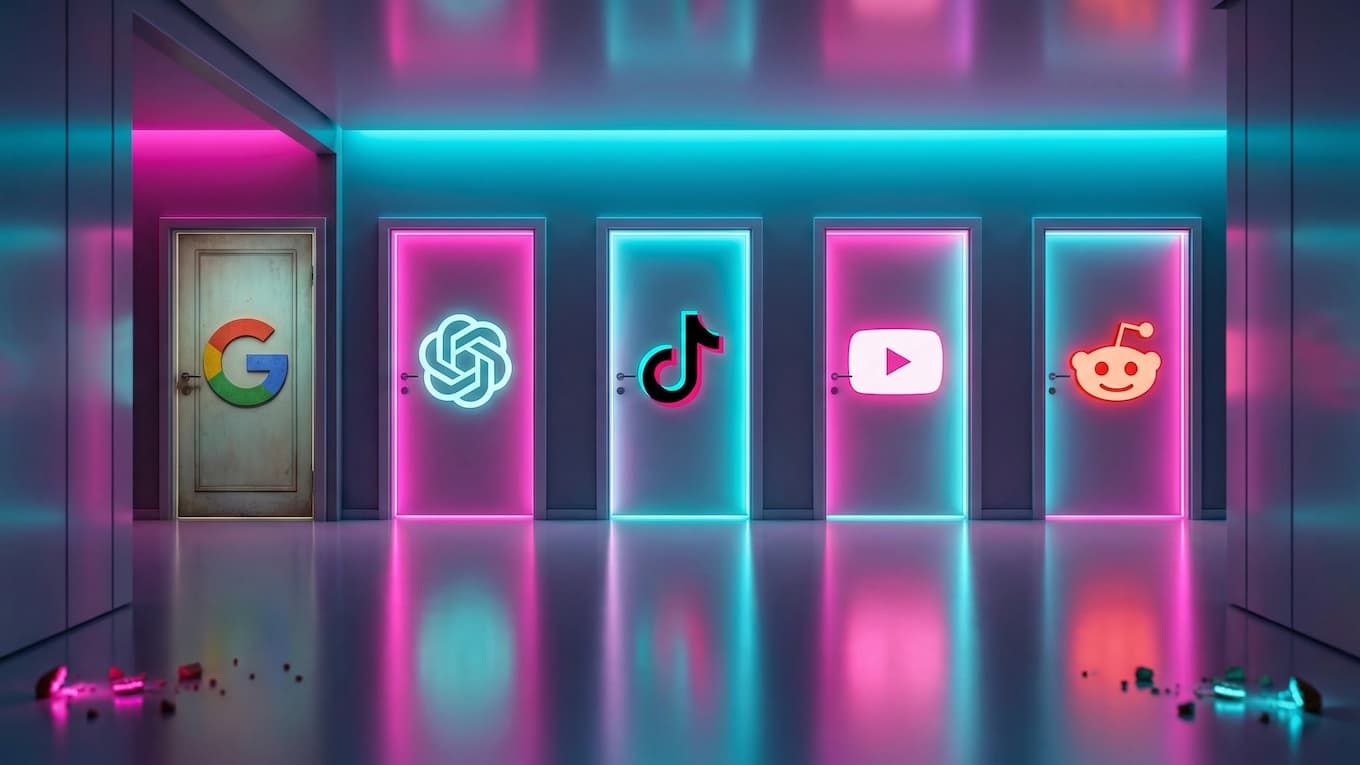
How AI, social platforms and communities are reshaping how people find things online.
I’ve spent the better part of 25 years trying to understand Google.
In the early days of SEO, that mostly meant experimentation. Directory submissions, forum signatures, reciprocal links, keyword density tweaks — if there was a theory about how Google ranked websites, I probably tried it.
Some of those tactics worked surprisingly well.
Which, in hindsight, says more about the state of early search engines than it does about my technical brilliance.
Back then, discovery on the internet was very predictable. If someone wanted to find something online, they started with Google.
Need product recommendations? Google it.
Trying to solve a problem? Google it.
Comparing options before buying something? Google it.
Entire industries were built around that assumption. SEO, content marketing, affiliate sites — all designed around a simple idea: if you could understand Google, you could control discovery.
And for a long time, that was largely true.
Google wasn’t just a search engine. It was the front door to the internet.
But that door is no longer the only way in.
Today, people discover products through TikTok videos, Reddit discussions, YouTube reviews and AI assistants like ChatGPT — something I explored in more detail in an earlier piece on why AI search tools are starting to pull users away from traditional search.
Google still plays a huge role — but increasingly it’s where people verify things rather than discover them.
In other words, Google used to own discovery.
Not anymore.
When Google Owned Discovery
For most of the internet’s history, discovery followed a remarkably simple pattern.
Someone had a problem. They opened Google. They typed a query. And the results page determined what they discovered next.
If your website appeared near the top of those results, you were visible. If it didn’t, you were effectively invisible.
It was that simple — and that powerful.
An entire industry grew around this model. Businesses invested heavily in search engine optimisation because ranking well in Google meant being found by customers at the exact moment they were looking for something.
For marketers, it created a very clear objective: understand how Google worked, and you could influence discovery.
That’s exactly what many of us spent years trying to do.
In the early 2000s, SEO felt like a strange mix of engineering experiment and detective work. You’d tweak a page, build a few links, adjust some keywords, wait a few weeks… and see what moved.
Sometimes the results were dramatic.
Sometimes nothing happened.
But one thing remained constant: Google controlled the starting point.
If someone needed advice, a product recommendation, or a solution to a problem, their journey almost always began the same way — with a search query.
The model looked something like this:
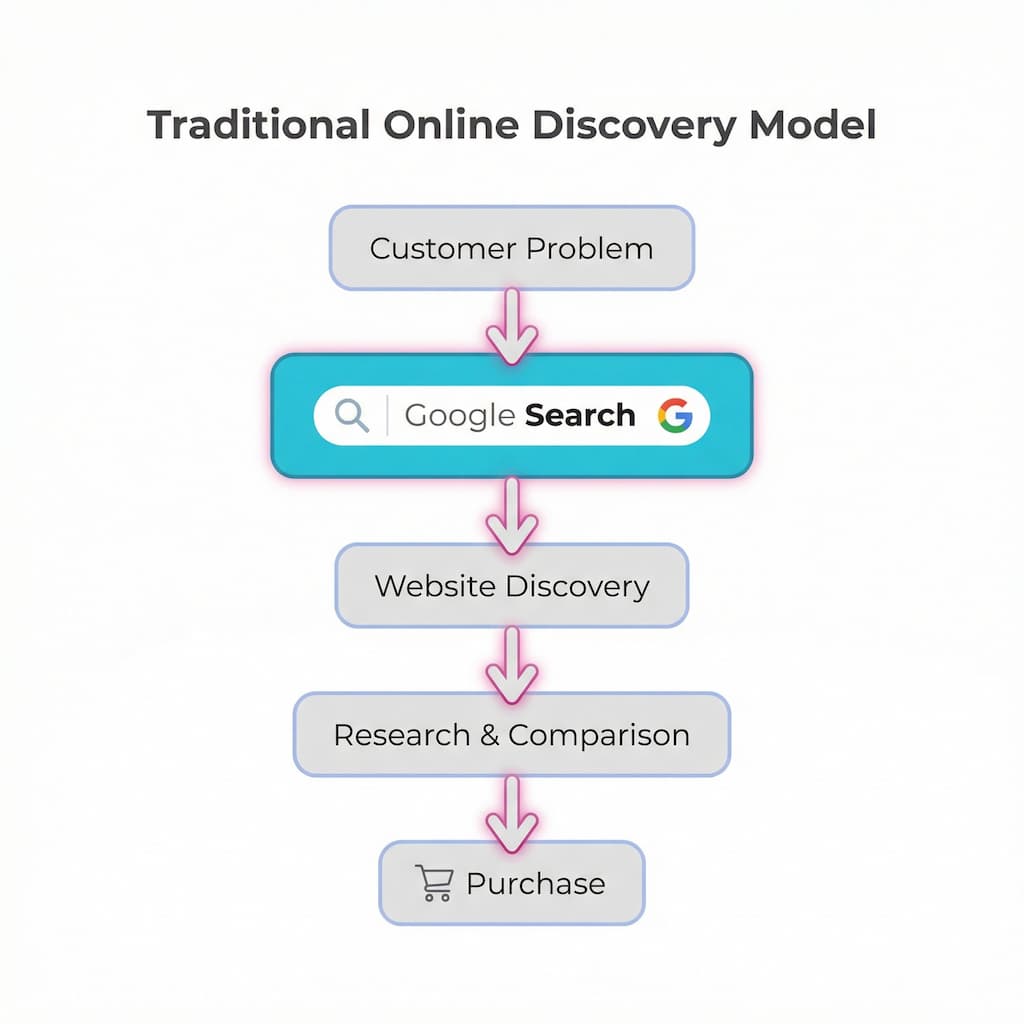
This structure shaped the entire digital economy.
Content marketing was built on it. Affiliate sites were built on it. Entire comparison industries existed purely to capture those research-stage searches.
If you could rank for the right query at the right time, you could intercept demand before a customer had even chosen a brand.
For two decades, Google effectively owned that discovery layer.
Which is why what’s happening now is so interesting.
Discovery Is Starting to Fragment
For years, the discovery model of the internet was remarkably centralised.
Google sat in the middle of almost everything. If someone needed information, a product recommendation, or advice before making a decision, search was the gateway.
But that model is starting to loosen.
Even when people use Google today, they increasingly don’t leave it. Research from SparkToro suggests that nearly 60% of Google searches now end without a click to another website.
In many cases the answer now appears directly in the search results through snippets, knowledge panels or AI summaries.
At the same time, discovery itself is spreading across new platforms.
People find products through TikTok creators. They watch YouTube reviews before buying something. They read Reddit discussions to understand what real users think. Increasingly, they ask AI assistants like ChatGPT for recommendations. — something that is already beginning to reshape how marketing and advertising work online.
Google itself has acknowledged the shift. During an industry conference, a Google executive noted that around 40% of younger users now turn to platforms like TikTok or Instagram for discovery instead of traditional search.
In other words, the first step of the journey is no longer guaranteed to be a search engine.
Sometimes discovery happens through a video. Sometimes through a conversation. Sometimes through an AI-generated answer.
Only afterwards do people turn to Google — often simply to confirm whether a brand or product is legitimate.
The discovery journey is starting to look more like this:
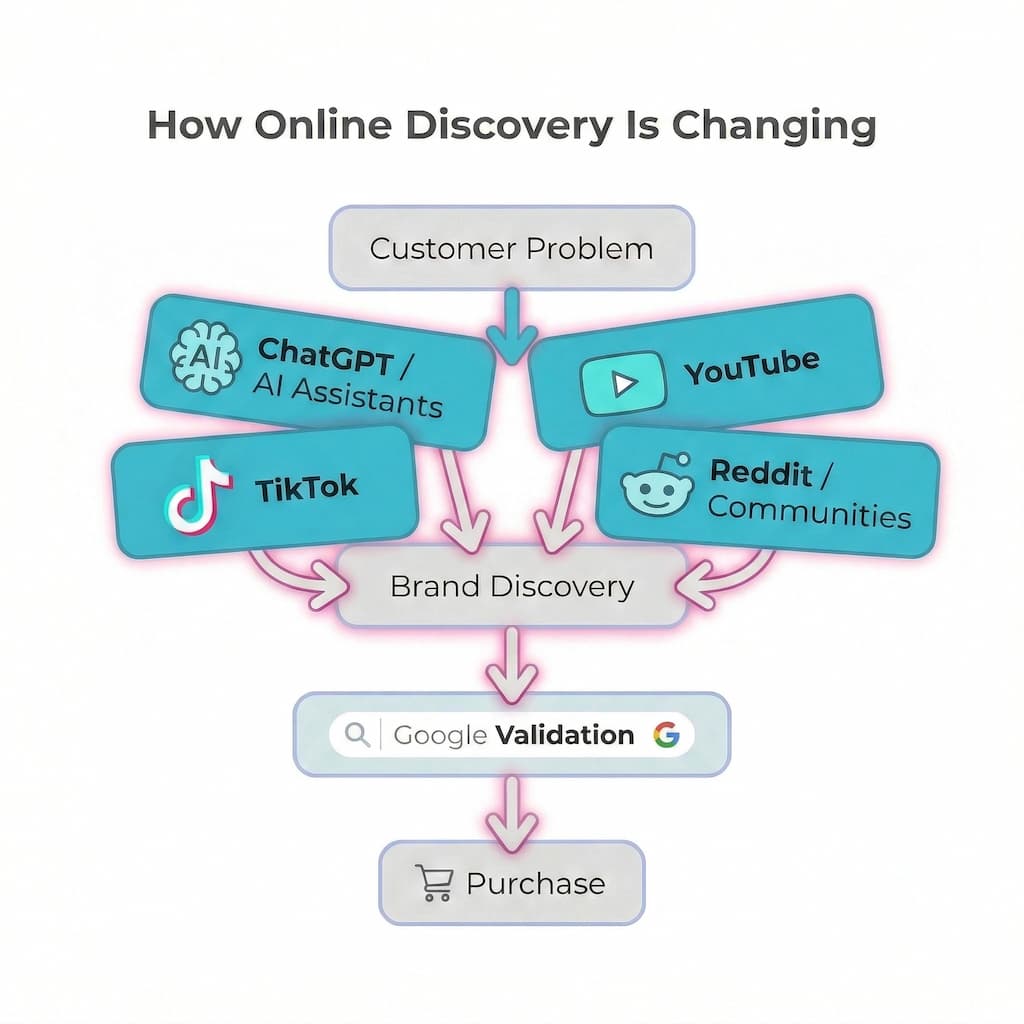
Google still plays a huge role in this process. In many ways it remains the internet’s most powerful information index.
But the starting point of discovery is becoming less predictable.
And that’s a meaningful shift.
Because when discovery fragments across multiple platforms, businesses can no longer rely on a single channel to be found.
The Shift I’m Seeing First-Hand
The research is interesting, but the change is even easier to see in everyday behaviour.
People don’t always arrive at websites the way they used to.
Years ago, you could often tell exactly how someone found you. A customer searched for a product category, clicked a result, compared a few options, and gradually worked their way toward a decision.
Now it’s increasingly common for people to arrive already knowing what they’re looking for.
Sometimes they’ve seen a product on TikTok. Sometimes they’ve watched a YouTube review. Sometimes they’ve asked an AI assistant for recommendations. Occasionally they’ve fallen down a Reddit thread that started with a simple question and ended three hours later with a surprisingly strong opinion about coffee grinders.
By the time they open Google, they’re often just confirming something they’ve already discovered.
Which changes the role Google plays in the journey.
Instead of being the place where discovery happens, it’s increasingly the place where discovery gets validated.
Someone might search a brand name to check reviews. They might look for a company website to confirm it’s legitimate. Or they might simply be making sure the thing they saw recommended somewhere else actually exists.
Google is still incredibly powerful.
But it’s no longer the only place where the journey begins.
For someone who spent years trying to reverse-engineer Google’s algorithm, this is… mildly inconvenient.
For businesses, however, it’s actually quite interesting.
Because when discovery starts happening in conversations, communities and recommendation engines, the rules of marketing start to change as well.
Why This Matters for Businesses
For businesses and marketers, this shift has an important implication.
For years, digital marketing largely revolved around a single objective: showing up when someone searched for something on Google.
If you ranked well, you captured attention. If you didn’t, you didn’t.
That model worked because discovery was highly centralised. Google was the gateway through which most online journeys began.
But when discovery starts happening across multiple platforms, the equation changes.
A potential customer might hear about a product in a YouTube review, see it mentioned in a Reddit discussion, or ask an AI assistant for recommendations. By the time they search Google, they may already have a shortlist in mind.
In that environment, simply appearing in search results is no longer the only way to be discovered.
Businesses increasingly need to be visible wherever conversations about their category are happening.
That might mean being recommended by creators. It might mean appearing in community discussions. It might mean building a reputation that AI tools and recommendation systems can recognise and surface.
In other words, discovery is becoming less about ranking pages and more about being talked about.
Which is a very different marketing problem to solve.
None of this means Google is disappearing. Far from it. Search remains one of the most powerful tools on the internet, and for many journeys it still plays a central role.
But the days when Google completely controlled discovery appear to be fading.
The internet’s front door hasn’t vanished.
There are simply more doors now.
And that shift has another consequence.
When discovery starts happening through recommendations, conversations and AI-generated answers, the traditional research phase of the customer journey begins to shrink.
Instead of reading multiple articles, comparing options and gradually forming an opinion, people increasingly receive curated answers in seconds.
Which raises an interesting question.
What happens to marketing when the research stage of buying starts to disappear?
That’s something I’ll explore in the next article.
FAQ’s
Google remains one of the most important tools on the internet, but it’s no longer the only starting point for discovery. Increasingly, people discover products and information through social platforms, communities and AI assistants before turning to Google to validate what they’ve found.
Not exactly. Social platforms are becoming powerful discovery channels, particularly for product recommendations and reviews. In many cases, people first discover a brand through social content and then use Google to verify or research it further.
AI assistants such as ChatGPT allow people to ask questions conversationally and receive curated answers instantly. Instead of searching multiple websites, users can receive recommendations in seconds, which changes how brands are discovered and evaluated.
Search optimisation still matters, but discovery is becoming more distributed. Businesses increasingly need visibility across social platforms, communities, and recommendation systems, not just traditional search results.
