
With 25 years managing Google Ads, Meta campaigns and ecommerce growth strategies — from early AdWords text ads through to AI-driven performance marketing — I’ve watched every major platform shift unfold in real time.
I remember when Google AdWords (yes, it was still called that) felt revolutionary — suddenly any small business could appear the moment someone typed “buy running shoes”. I’ve built search campaigns in the era of manual CPC bidding, navigated the rise of Facebook’s behavioural targeting engine, optimised YouTube’s shift from skippable pre-roll irritation to shoppable inventory, and managed budgets through every algorithmic twist in between.
Each platform promised the future. Each disrupted the old guard. And each eventually built a monetisation machine around user intent.
And now? OpenAI has begun testing ads inside ChatGPT. The rollout is currently limited to a subset of logged-in US users on the Free and Go tiers, while premium plans such as Plus, Pro, Business, Enterprise and Education remain ad-free. From here in the UK, it’s still a US-only experiment — but when Silicon Valley identifies a viable revenue stream, international expansion rarely lags far behind.
From Google Ads to AI: How User Behaviour Keeps Moving
In the early 2000s, Google Ads made intent-based marketing accessible to everyone. The 2010s brought behavioural targeting at scale — ads that felt eerily personal (sometimes too personal). YouTube turned video into commerce.
These platforms scaled because they met users where they already were. But they all relied on the same predictable dance: type a query, scroll a feed, watch a clip, click an ad.
Fast-forward to 2026, and something genuinely different is happening.
As I wrote in my earlier piece, “For the First Time in 20 Years, I’m Using Something Other Than Google — And That’s a Big Deal”, AI search tools like ChatGPT are quietly pulling people away from traditional engines.
The behavioural shift isn’t just anecdotal.
McKinsey research from late 2025 found that around half of consumers are intentionally using AI-powered search engines.
Harvard Business Review reported that 65% of Gen Z respondents had used an AI chatbot as a replacement for Google in the past month.
Gartner predicted in 2024 that traditional search engine volume could drop 25% by 2026 due to AI chatbots and virtual agents.
It’s not a total takeover — yet. But the direction of travel is clear.
And OpenAI has spotted the opportunity: if users are turning to ChatGPT for answers, why not monetise those conversations directly?
Monetisation Enters the Conversation
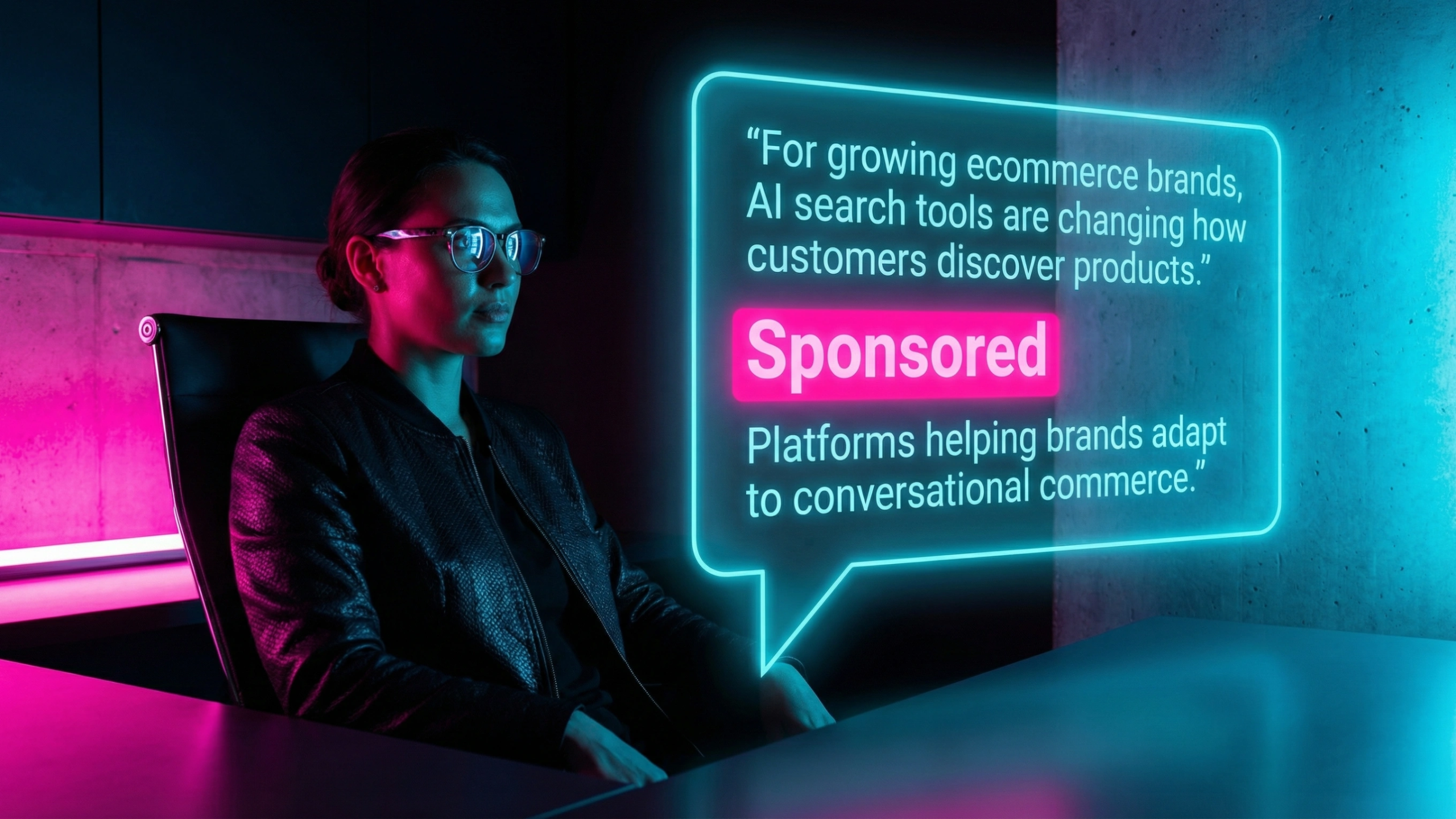
These new ChatGPT ads are clearly labelled “Sponsored”, positioned beneath relevant responses, and — at least for now — do not interfere with organic answers. Sensitive categories such as health, mental health and politics are reportedly excluded.
Early industry reporting has suggested premium pricing, with some sources citing rates as high as $60 per 1,000 impressions.
High-intent, low-noise inventory. Sound familiar? It should.
It echoes early Google Ads — restrained placements, strong relevance, and premium positioning built on user intent.
The Economics Behind the Shift
Running large-scale AI systems is extraordinarily expensive. Infrastructure and compute investment across the sector is already measured in the tens of billions.
At the same time, ChatGPT now serves hundreds of millions of users globally — many on free tiers. Advertising is an obvious monetisation lever.
From a strategic standpoint, it makes sense.
That said, early-stage monetisation models often evolve significantly. What we’re seeing now may not reflect the long-term structure of conversational advertising. Inventory limits, targeting rules, data usage policies and placement visibility could all shift as the model matures.
It’s also worth remembering that early enthusiasm doesn’t guarantee sustained adoption. User tolerance for advertising inside AI systems remains largely untested at scale. The challenge for OpenAI won’t be launching ads — it will be scaling them without eroding the trust that made ChatGPT valuable in the first place.
To understand why this shift matters, it helps to compare traditional search advertising with emerging conversational placements:
Traditional Search vs Conversational AI Advertising
| Traditional Search Advertising | Conversational AI Advertising |
|---|---|
| Keyword-triggered queries | Natural language prompts |
| Multiple blue links | Synthesised responses |
| Paid listings above or below organic results | Sponsored placements embedded within conversations |
| Optimised for click-through | Optimised for contextual relevance |
| Behaviour and keyword targeting | Real-time conversational intent signals |
| User scans options | User receives a distilled answer |
Why This Matters for Marketers
The biggest advertising opportunities in the past 25 years have emerged when user behaviour shifted:
- Search intent (Google)
- Social behaviour (Meta)
- Video consumption (YouTube)
- And now — conversational intent
For ecommerce brands and marketers, this is worth watching closely.
It’s early. Inventory is limited. Pricing is premium. But so was Google in the beginning.
The bigger question may not be whether ChatGPT ads will perform — it’s whether conversational AI remains neutral enough to retain user confidence once monetisation scales.
FAQ’s
At present, reporting suggests the rollout is limited to certain logged-in users in the United States. OpenAI has not yet confirmed a timeline for broader international expansion. As with most platform monetisation experiments, geographic rollout will likely depend on performance data, advertiser demand and regulatory considerations.
UK advertisers should monitor developments closely, particularly if conversational search adoption continues to grow across Europe.
Unlikely in the short to medium term. Google Search remains deeply embedded in user behaviour and commercial discovery, particularly for transactional queries.
A more probable outcome is diversification rather than replacement. Conversational AI advertising may develop into a complementary channel — particularly for high-intent prompts where users are actively seeking recommendations, comparisons or solutions.
Search advertising is unlikely to disappear, but its dominance may gradually rebalance as AI interfaces evolve.
Early indications suggest that ads are triggered by conversational context rather than traditional keyword bidding alone. Sponsored placements appear beneath relevant responses and are clearly labelled.
Instead of matching short search phrases, conversational placements may respond to full-sentence prompts. This could allow for more nuanced intent alignment than conventional search advertising, though targeting and reporting structures may evolve as the system matures.
At present, access appears limited and not publicly self-serve in the way Google Ads or Meta Ads are. As the programme develops, OpenAI may introduce a formal advertising platform with defined targeting, bidding and reporting tools. Businesses interested in early adoption should monitor announcements closely and ensure their product messaging is aligned with high-intent conversational queries.
Early indications suggest ads are triggered primarily by conversational context rather than traditional keyword bidding alone. Instead of matching a short search phrase, placements may respond to full-sentence prompts, which could enable more nuanced intent matching than conventional search advertising.
If conversational AI adoption increases significantly, traditional search volumes could decline over time, potentially affecting SEO-driven traffic. However, most evidence suggests AI tools currently complement rather than fully replace search engines. Businesses should monitor behavioural trends rather than react prematurely.
